

The Real-Time Report on the Operation of Leisure Games in the First Half of 2025 (Casual LiveOps Report H1 2025), published on July 30 by Appagic, a mobile application market intelligence tool, paints a mixed picture: Despite the continued growth in the number of downloads of leisure games since the beginning of the year, income growth has almost stagnated, showing a “good or no seat”.

According to the report, the global number of leisure hand-downs from 2024 to 2025 was 30.2 billion, an increase of 6 per cent over the previous year, driven mainly by winter months. During the same period, however, income performance was far from satisfactory, with global income increasing by only 3.6 per cent to $23.8 billion. The focus on data for the first half of the year, with a healthy increase in downloads of 5 per cent compared to the same period last year, was largely the same as income, with a change of less than 1 per cent, highlighting the disconnect between increased user size and realized efficiency.
The report highlights income trends in the first half of 2025 in the first half of the year, with data showing dramatic changes in regional market patterns. While the United States and China still hold the top two on the global revenue list for leisure-players, both countries experienced a significant decline in the first half of 2025: US revenues fell by 7.06 per cent and China by 7.31 per cent. This contrasts sharply with the strong performance of the Japanese market, whose revenues rose by 21.8 per cent over the same period, becoming a bright spot in the bleak market.
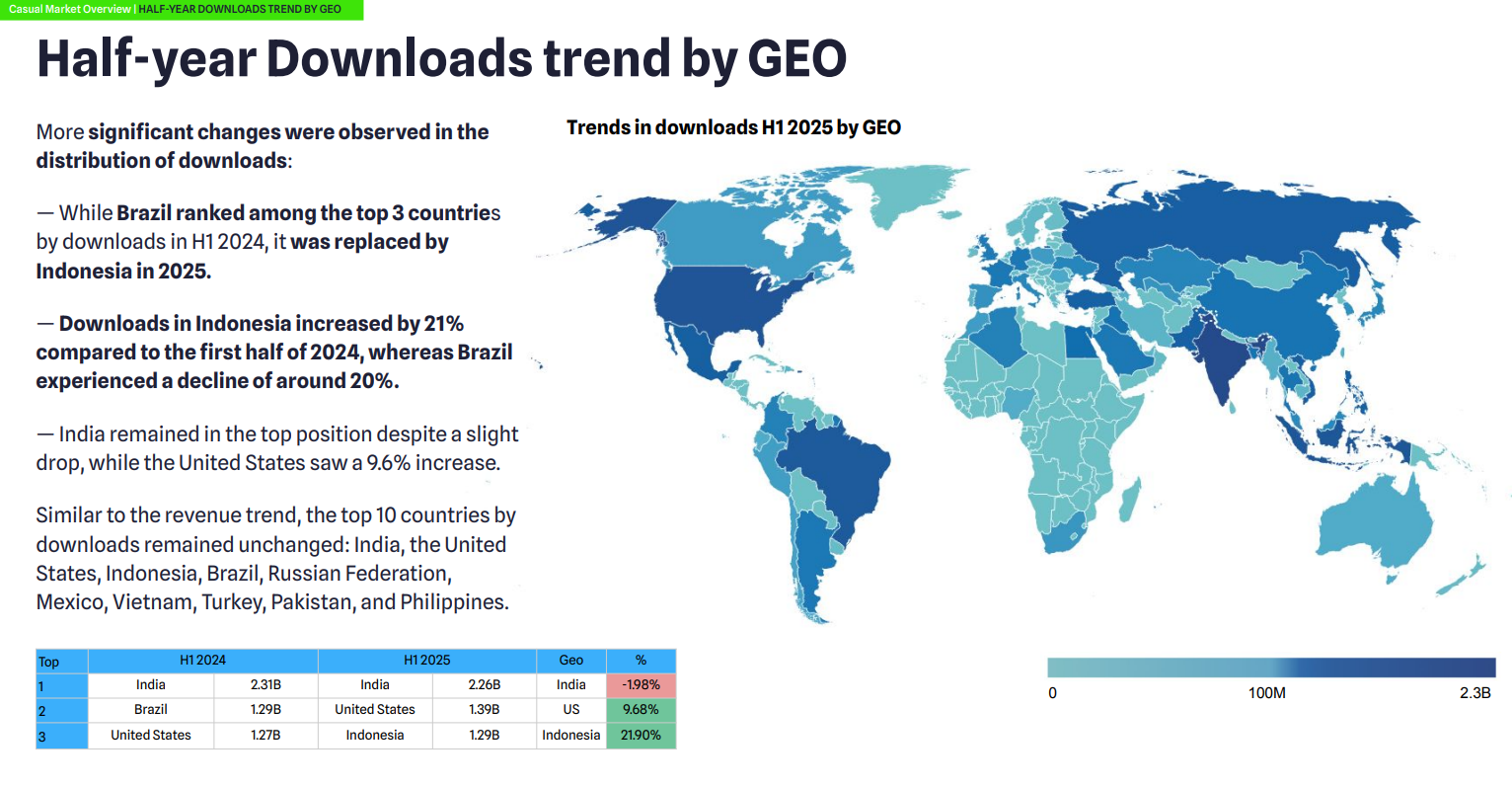
The changes in the ranking of downloads are equally remarkable. Brazil, ranked three in the first half of 2024 (along with India and the United States), fell three in 2025 and was replaced by Indonesia. In Indonesia, downloads increased sharply by 21 per cent in the first half of the year, while in Brazil they declined significantly by 20 per cent. India and the United States have maintained the lead in downloading.
In the area of gaming and playmanship, tactless decryption, gaming and simulating are still the most lucrative troikas in the field of leisure games. Among them, the intelligence declassification class showed a particularly strong performance, with an increase of 13.2 per cent in income in the first half of 2025. In the game trend, “competition speed mechanisms” have become the standard for head products, and up to 70 per cent of top leisure games have adopted such designs. In the “IP Partnership” of external traffic and user sentiment, 25 per cent of the head-leave game followed by AppMagic has been launched at least once this year. By contrast, the fishing scheme is clearly unpopular, and the report states that the game is “not universal” and “not in the new head game”.

Taken together, the report reveals the key dynamics of the leisure hand-to-hand market in the first half of 2025: against the backdrop of a sustained growth in the user base (download) income growth bottlenecks, reflecting increased market competition and increased liquidity pressure. Traditional dominant markets show fatigue, while Japan (income) and Indonesia (download) are becoming new engines of growth. For developers, hugging popular play mechanisms such as “pacing”, actively engaging in IP cooperation to attract users, and deeply ploughing income-resilient cores such as charades, will be important strategies to cope with the current market situation of “good or bad seats” and seize opportunities in a regional pattern shuffle.